
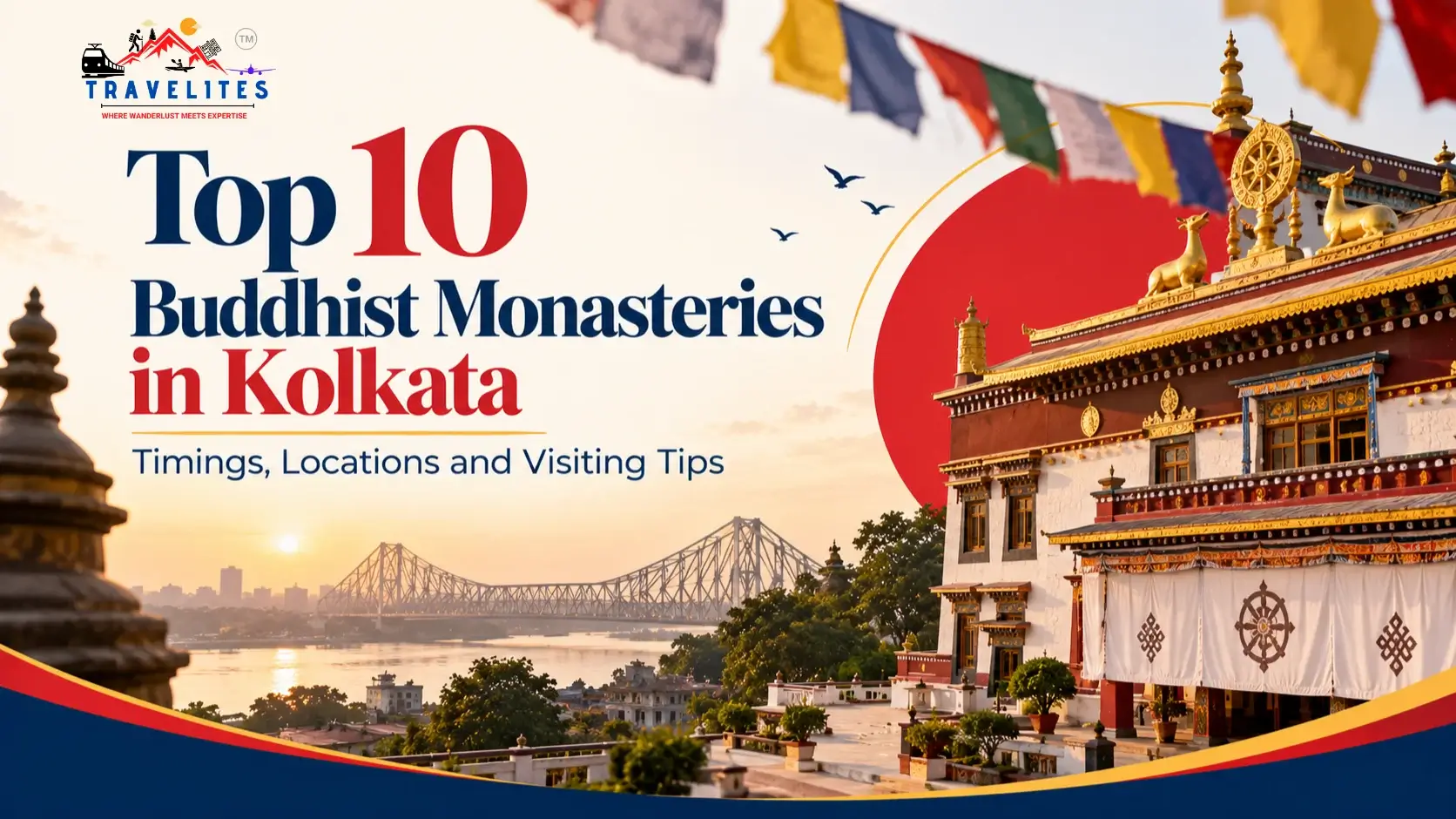
When people plan a trip to the City of Joy, they think of Victoria Memorial, Howrah Bridge and the Durga Puja pandals. Few think of a Buddhist monastery in Kolkata, yet the city has a quiet network of them: a society founded by a Sri Lankan reformer, Burmese and Japanese temples, Chinese monasteries in Chinatown and a Tibetan gompa tucked between apartment blocks.
Here are ten worth your time, with what to expect at each, how they cluster into easy day plans, and the etiquette that keeps a visit respectful.
Which Monastery Should You Visit? Quick Picks
| If you want… | Go to |
|---|---|
| The most important, easiest first visit | Maha Bodhi Society, College Square |
| Calm, silence and a garden | Japanese Buddhist Temple, Dhakuria |
| Food with your temple visit | Fo Guang Shan, Tangra |
| A Himalayan feel inside the city | Hsuan Tsang Monastery, Paschim Chowbaga |
| Tibetan Buddhism | Karma Gon Monastery, Chakraberia |
| A hidden, history-rich stop | Myanmar Buddhist Temple, Eden Hospital Road |
| Something off the tourist trail | The Chinese Buddhist temple on Jessore Road |
1. Maha Bodhi Society (Dharmarajika Chaitya Vihara), College Square
This is the best-known Buddhist address in the city and the natural starting point.
The Maha Bodhi Society was set up in 1891 by the Sri Lankan Buddhist reformer Anagarika Dharmapala to restore Bodh Gaya, and it has been headquartered in Kolkata since 1892.
Its shrine, the Dharmarajika Chaitya Vihara, opened in November 1920 and was inspired by the Ajanta caves. Inside, bright frescoes tell the story of the Buddha’s life, and a relic casket sits in a black stone pagoda. The relic is displayed on Buddha Purnima, when the vihara is at its busiest.
Where: 4A Bankim Chatterjee Street, beside College Square. Good to know: Visitors have reported morning and evening opening windows, with prayers around 7 am and 7 pm, so check current timings before you go.
2. Japanese Buddhist Temple (Nipponzan Myohoji), Dhakuria
If you are looking for a Japanese temple in Kolkata, this is it: a white, gold-trimmed temple in a landscaped compound on Lake Road (Kabi Bharati Sarani), close to the Dhakuria flyover and the Rabindra Sarobar side of the lake.
The founder, Nichidatsu Fujii, was a Japanese monk who came to India in 1931 and became a friend of Gandhi, who is said to have called him “Guruji”.
The temple was built in 1935 on land donated by the Birla family. Today it is run largely by monks from North-East India, with chanting and drumming in the early morning and evening, and visitors of every faith are welcome.
Good to know: Keep your voice low, and expect restricted entry while prayers are on. Photography is usually fine if it is silent and respectful. This is not the same as the Japanese Temple and Peace Pagoda in Darjeeling, a separate Nipponzan Myohoji temple built in 1972.
3. Fo Guang Shan Buddhist Temple, Tangra
Founded in 1998 by the Taiwan-based Buddha Light International Association, this Mahayana temple at 8 New Tangra Road is built around a large golden Buddha.
Upstairs is a library of Buddhist texts, and free Chinese calligraphy sessions have been offered on request, with the resident nun describing calligraphy as a form of meditation.
Its unusual draw is a vegetarian eatery serving Chinese, Taiwanese and Indonesian dishes, listed in earlier guides as open from about 11 am to 6 pm on weekdays. Call ahead or check recent reviews before planning lunch around it.
4. Hsuan Tsang Monastery, Paschim Chowbaga
Many visitors say this two-storey monastery feels closer to the Himalayas than to a city lane. Both floors have prayer halls, and the upper hall has brightly coloured frescoes.
The complex is named for the seventh-century Chinese traveller Xuanzang and includes a memorial hall with his statue that doubles as a library of Chinese Buddhist books.
A small Chinese cemetery sits next door. It serves Kolkata’s Chinese Buddhist community and pairs naturally with Fo Guang Shan on a Tangra and Chinatown morning.
5. Myanmar (Burma) Buddhist Temple, Eden Hospital Road
You can walk past this one without noticing. The Burmese temple at 10A Eden Hospital Road, near the Central Avenue crossing, occupies an ordinary three-storey building, and two small boards are the only clue.
It was established in 1928 by U San Min. The shrine is on the top floor, the ground floor is let out to fund upkeep, and the first floor is a guesthouse for visiting Burmese monks.
The temple appears in Amitav Ghosh’s novel The Glass Palace. The resident monk has been known to invite visitors to meditate, but one reader found him away, so it is worth confirming he is in town.
6. Dharmankur Buddha Vihar, Bow Barracks
At the edge of the historic Anglo-Indian Bow Barracks, Dharmankur Vihar was established in 1903 and is run by the Bengal Buddhist Association, which dates to 1892.
A small ground-floor shrine with a golden Buddha opens onto a courtyard, and the complex includes a library and a basic guesthouse that welcomes guests of all faiths.
It is one of the city’s oldest centres of Buddhist life and pairs well with the Maha Bodhi Society, since both sit in the central part of the city.
7. Karma Gon Monastery, Chakraberia
Squeezed between apartment blocks off a narrow lane in the Padmapukur area, Karma Gon belongs to the Karma Kagyu (Black Hat) school of Tibetan Buddhism.
The story begins in the 1930s, when a monk named Akka Dorjee came from Darjeeling and built a small mud-hut gompa in 1937.
It came under the Rumtek Monastery of Sikkim in 1971, and the present building dates to 1976-77. Inside is a hall of Tibetan deities, with a small shrine and stupa on the roof. It is the best place in the city to see Tibetan prayer practice at close quarters.
8. Chinese Buddhist Temple, Jessore Road (Lake Town)
Searching for the China Mandir on Jessore Road? This is the one. Officially at 426 Jessore Road, down a narrow lane between the Lake Town and Bangur sides, it opened in 1962 and was extended in 1972.
A large central hall and several smaller shrines surround a library of handwritten religious texts.
It is quiet, modestly maintained and rarely crowded, looked after by a caretaker rather than a large community, so go in daylight and expect a low-key visit. For travellers who like places that are not on every list, that is the appeal.
9. Buddha Temple at Milan Park, Garia (lesser-known)
Local readers point to a Buddha temple in the Garia area near Milan Park as one more option for the south of the city. It does not feature in most guides, so treat it as a short, local detour rather than a destination, and ask around for current timings.
10. Burma Colony Pagoda and Buddha Statue, Madhyamgram (lesser-known)
Outside the municipal limits but easy to add to a northern day trip, the Madhyamgram area has a Buddhist pagoda founded in 1963 by Bengali Buddhists who returned from Burma, in a neighbourhood once called Burma Colony.
Nearby, in Digberia village, is a large eight-metal Buddha statue reported to be 20 feet tall and brought from Thailand in 2005. Both are known mostly through local knowledge, so confirm the way and the timings before you set out.
Looking for a “China Mandir”? Which One Do You Mean?
In Kolkata, “China Mandir” can point to several different places, and mixing them up wastes a trip:
- Chinese Buddhist temple, Jessore Road (Lake Town): the Buddhist temple described above.
- Chinese Kali Mandir, Tangra: a Hindu temple to Goddess Kali, built through the Chinese and Bengali communities and known for offering noodles and chop suey as prasad. It is not a Buddhist monastery.
- Old Chinatown temples, Tiretta Bazar: a cluster of traditional Chinese community temples and association halls, such as Nam Soon, believed to date from the 1820s.
How to Combine Them: Three Easy Routes
- Central heritage morning: Maha Bodhi Society, the Myanmar temple and Dharmankur Vihar, all in the older central parts of the city.
- Chinatown morning: Fo Guang Shan and Hsuan Tsang Monastery in Tangra, with lunch at the temple eatery if it is open.
- South Kolkata stillness: the Japanese temple in Dhakuria, ideally at prayer time, then a slow walk around Rabindra Sarobar, with Karma Gon as an optional add-on.
The Jessore Road temple suits a day when you are already heading to or from the airport side of the city.
Etiquette: What to Do and What to Avoid
- Dress modestly and remove your shoes before entering a prayer hall.
- Speak softly, silence your phone and avoid walking in front of someone who is meditating.
- Ask before photographing monks or the main Buddha image.
- Avoid arriving in the middle of a prayer session unless you plan to join quietly.
- A small donation is appreciated, especially at the smaller, community-run temples.
When to Go
The cooler months, roughly October to February, make temple-hopping most comfortable. Buddha Purnima, in April or May, is the most atmospheric day, with the Maha Bodhi relic on display, but expect crowds.
Early morning and early evening are the best times for chanting, and many temples keep a rest period in the afternoon.
A Short History Behind the Monasteries
Bengal was a Buddhist heartland under the Maurya and Pala dynasties, but Buddhism faded after the twelfth century. The modern revival in Kolkata came through the Maha Bodhi Society and the Bengal Buddhist Association in the 1890s, followed by Burmese, Japanese and Tibetan communities.
Chinese Buddhism arrived with migrants who came from the late eighteenth century. This layered story is why the city’s temples look so different from one another.
Planning Your Trip
Most people see these temples as part of a wider Kolkata trip. If you would like them folded into a heritage walk with Chinatown, College Street and the Armenian and Jewish quarters, you can ask for a private Kolkata heritage and sightseeing tour.
If you have an extra weekend, many travellers pair the city with a Sundarbans safari, and those drawn to monasteries often continue to the mountain monasteries on a Sikkim and Darjeeling Buddhist circuit. For groups or custom plans, get in touch with our team.